WELCOME TO TISA'S WORLD
by Tisa N. Herlec
2021
masters thesis
XPUB: Experimental Publishing
Piet Zwart Institute
Rotterdam, The Netherlands
Improvisation
I am here attempting to outline the dynamic, the net of the current social
order as observed from my own situated perspective - to shine a light upon
it and to, in my praxis, devise a tentative, dynamic infrastructure (along
with methodologies) that could reverse this faulty logic of individualism.
Where to start if not with a practice that is collective, and yet it
empowers the very subjects that constitute the multiplicity?
I reclaim my potentialities through the praxis of improvisation. I believe
that improvisation actively enables the subject to engage in the process of
emancipation that happens in real-time, through the act of improvising
together with others - interacting and communicating in an open space,
loose from all predetermined structures, power dynamics, rules, in a way
suspended from the mundane reality. A space that is open to play and filled
with possibilities for the enjoyment of collectively constructed
imaginaries.
I consider improvisation as a strategy for emancipation and the training
ground for interacting and communicating, empowering our spirits, agencies
and potentialities.
I find myself the most lively and emancipated when I improvise together
with others, and when I find myself in situations that are built upon the
principle of improvisation. I mostly do that in the medium of sound with my
voice, in an improvised music genre that is known as free improvisation or
instant composition. I also do it while I paint and write, and more.
Actually, improvisation does not pertain to any media or material, it is a
structural dynamic that can be applied to any medium of expression.
In fact, the only times we don't improvise is when we strictly follow the
prescripted social contracts and bureaucratic processes. Apart from that,
every interaction, conversation and movement is done in an improvisatory
fashion, in real-time.
Improvisation is an intrinsic capacity of every human being (of nature as
well).
The ones that know this the most are children, free in the ways they
express, interact and disobey the social contract (without even knowing
there is one in place).
One of the works that belong to The Constitution of my praxis is "The Side
Entrance", a radio show in which I have been making interviews with
practitioners of improvisation. Radio Worm has provided me with the
technical infrastructure and a temporal frame. From January 2021 to X, I
have interviewed X guests in my weekly radio show. We spoke about the
backstage of their work, entered into their conceptual worlds as well as
listened to its sound materializations - music pieces. The archive of the
show is accessible here: https://pzwiki.wdka.nl/mediadesign/User:Tisa/III
Together with them, discursively, I was investigating the field of
improvisation and some crucial concepts that pertain to it: flow,
methodologies and infrastructures, archiving, the conception of mistakes,
fear, empowerment, agency and interactive potentials, listening.
I believe that my own praxis of improvisation teaches me how to overcome
fear and be courageous, to locate my own liminalities, to let go of
judgement.
It allows me to make choices in real-time and to explore the state of flow
- a state where potentialities are being manifested without a predetermined
goal of arrival.
With it, I am becoming a friend of ever-present change. Nothing is a
mistake. I embody the flow of change. I consider change as the only
constant.
I exercise my own agency, explore my imaginary and non-conscious, and
oftentimes surprise myself with new thoughts, ideas and sensations that I
have never felt before. The state that I reach when I improvise is a
generative one.
I encounter different versions of myself when I improvise, actualize my
hunches and strive towards fulfilling my interactive and communicative
potentials. This requires sensibility and awareness to internal and
external impulses/triggers, to which I react and act upon.
I am unlearning, dynamicizing my knowledge and my habitual, normalized
behavior, granting myself new perspectives on myself and others involved.
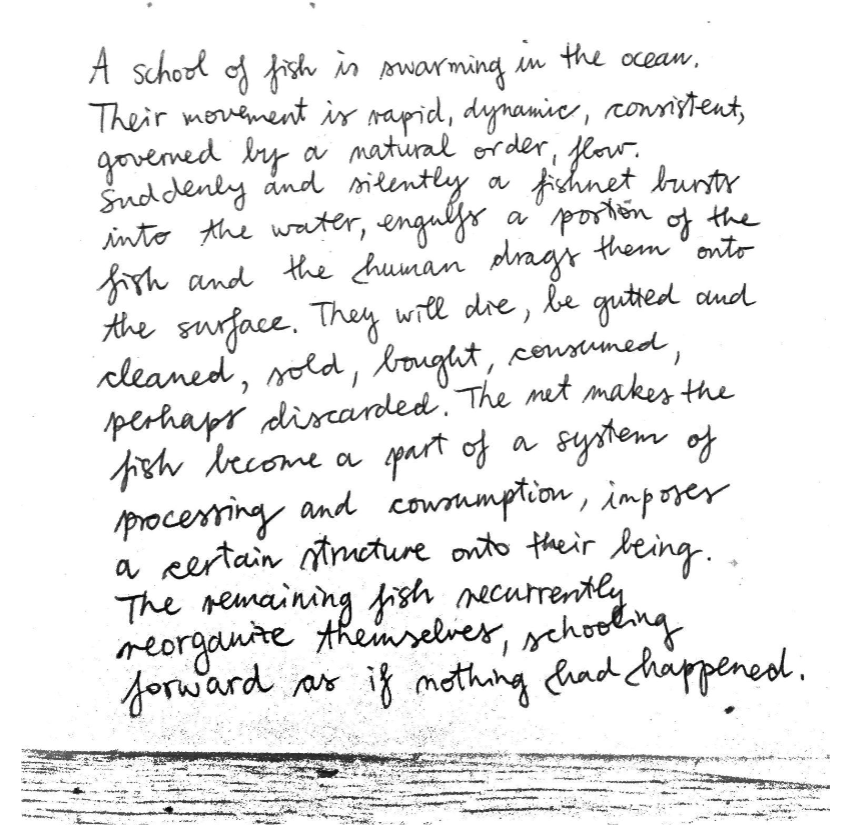
I observed the framing structures of the fishnet, which afforded me to
understand my own praxis of improvisation as an infrastructure that allows
my works and thoughts and actions to emerge.
I have, in this time, composed the net in which the substances can be
captured in - an infrastructure of my praxis that is fluid and changes,
mutates and recomposes with time. I have established an array of little
compositions or protocols that allow me to conduct experiments in order to
get data to further analyse, loop back into the practice, learn and expand.
I believe that in the instances when improvisation is exercised can teach
anyone about themselves, the interaction potentials and the world. It is a
safe space, a space for prototyping and testing, generating content and
realizations that can be resynchronized and invited into the everyday, as
soon as they happen and enter into our perception.
A passage occurs, a dynamic of movement from one system to the other.
Voice
A potent branch of my research (that could deserve to have many more pages
written about) is the very notion of communication within improvisation.
When I improvise in the medium of sound, I use my voice. Voices are
inherently linked to communication and language. Voice is the primal
instrument that everybody has. Just as it is with the human brain - the
capacity of the voice is much higher than the ways that we use it for
regularly.
I experiment with its potentialities of making sounds that my vocal
apparatus is not habituated to. Extended vocal techniques allow me to
express more and differently. Meaning-making is enabled with and without
language and logos. When I improvise with my voice, I often make up poetry
on the spot, or read, or speak in a made-up language (gibberish), or have a
fluid language schema in which I shift between the languages that I speak
(Slovenian, English and French), or make sounds that do not carry a
consolidated meaning. Sometimes I sing nicely and melodically, other times
I scream or whisper or chant. All of these modalities are permitted, and
mostly the decision on which one to use are made in the moment of
vocalizing, oftentimes non-consciously.
My voice does not function as an extension of my body, but rather as an
amplification device of my internality, something that reaches beyond the
constraints of my material boundaries (my surface, my skin) and that echoes
out into the open space, reaching others. I think a lot about the
empowerment of the human voices. Of the possibilities for communicating
beyond language and logos. Of opening up and exploring our voices and
training them to sound loud and clear and confident, able to express our
own subjectivities and communicate (with language or without it).
Mostly I improvise together with others. I believe that improvisation,
unbound by language is the purest expression of interaction. The structural
dynamics that happen within sound can be applied to other instances of
relating to each other, especially conversing and also relating to each
other while working together (team/group dynamics).
Emphasis is put on multiplicity, the beauty of difference (equality in
difference), communication and interaction. Improvisation in sound is
merely a net that captures potentialities onto its surface. The substance
is always under-construction, a continuous (re)arrangement of
subjectivities is happening, knowledges and oculuses are brought to
attention, exchanging with and within the environment that enables it.
(Remember what the Lyrebird has taught us?)
Her letter:
I thought that I would, in this thesis, explore the friction between
composition and improvisation. In the course of my research, it had
occurred to me that these types of hegemonic binaries are useless to work
with. The Lyrebird is the one responsible for this insight, as well as my
experiences of conversations with all the people I have encountered this
year. I have shifted my gaze towards other dynamics, the ones that do not
know the bit computing-like binary.
I have, after the outraged letter from the fishnet, submerged into my
improvisational praxis more. It allows me to generate and practically
assess and test my hunches about the structures that I have located within
it. My response to the fishnet's letter is my work. Dear reader, you can
float around it here, on my wiki page, where more and more works that I
have made will be archived, a totality of my praxis that is, sometimes even
for myself impossible to grasp.
Download by clicking
on the icon below
a solo vocal performance at RIB, Rotterdam;
a part XPUB masters thesis presentation
The Constitution
a solo vocal performance at RIB, Rotterdam;
a part XPUB masters thesis presentation